.webp)
How AI Is Helping Chemists Make Smarter, Faster Decisions in Labs
What if you could predict chemical reactions, discover new molecules, and analyze complex research data in minutes instead of weeks? That's exactly how AI is transforming modern chemistry. From accelerating drug discovery to optimizing laboratory workflows and reducing costly trial-and-error experiments, AI-powered chemistry tools are helping researchers make smarter, faster decisions than ever before. In this guide, we'll explore the best AI chemistry tools of 2026, compare their features, pricing, and ideal use cases, and show you which platform is best suited for your research, laboratory, or organization.

 Updated: April 26, 2026 | 22 min read
 Quick Comparison Table
| Tool | Best For | Free Plan | Primary Focus | Ease of Use |
| IBM RXN for Chemistry | Synthetic & medicinal chemists | ✅ Yes | Reaction prediction & retrosynthesis | ⭐⭐⭐⭐☆ |
| ChemCopilot | Chemical engineers & R&D teams | ❌ No | Chemical process optimization | ⭐⭐⭐⭐☆ |
| CAS SciFinder | Research scientists & academics | ❌ No | Chemical literature & substance search | ⭐⭐⭐☆☆ |
| Albert Invent | Enterprise R&D teams | ❌ No | Laboratory collaboration & R&D management | ⭐⭐⭐⭐☆ |
| Luna.ai | Scientific research teams | ⚠️ Varies | AI-powered research assistance | ⭐⭐⭐⭐☆ |
| Schrödinger Materials Science Suite | Materials scientists | ❌ No | Computational chemistry & materials modeling | ⭐⭐⭐☆☆ |
| AlphaFold | Structural biologists & protein researchers | ✅ Yes | Protein structure prediction | ⭐⭐⭐☆☆ |
| Atomwise | Drug discovery organizations | ❌ No | AI-driven drug discovery | ⭐⭐⭐⭐☆ |
| ChemGPT | Chemists, students & educators | ✅ Yes | AI chemistry research assistant | ⭐⭐⭐⭐⭐ |
| Chemistry Assistant by HyperWrite | Students & educators | ✅ Limited | Chemistry writing & learning assistance | ⭐⭐⭐⭐⭐ |
| Citrine Informatics | Materials R&D teams | ❌ No | Materials discovery & optimization | ⭐⭐⭐☆☆ |
| Molecule.one | Synthetic & organic chemists | ✅ Limited | Retrosynthesis planning | ⭐⭐⭐⭐☆ |
| Benchling | Biotech & pharmaceutical labs | ✅ Limited | Laboratory data management & collaboration | ⭐⭐⭐⭐☆ |
| Syntelly | Organic & medicinal chemists | ⚠️ Varies | Chemical reaction analysis & synthesis planning | ⭐⭐⭐⭐☆ |

Cover photo How AI Is Helping Chemists Make Smarter, Faster Decisions in Labs
Why Chemistry AI is Now Essential
AI is revolutionizing chemistry by accelerating molecular discovery, optimizing reactions, and automating data analysis. Technologies like machine learning and self-driving labs help chemists process complex datasets, reduce trial-and-error, and develop materials, catalysts, and polymers faster while enabling greater scientific innovation and research efficiency.
Benefits of Using AI in Chemistry Labs
Artificial intelligence is transforming chemistry laboratories by helping researchers analyze complex data, predict molecular behavior, and automate repetitive tasks. Instead of relying solely on trial-and-error experiments, chemists can use AI to identify promising compounds, optimize reaction conditions, and make data-driven decisions more quickly. This leads to faster discoveries, lower research costs, and improved laboratory productivity while allowing scientists to focus on innovation rather than manual analysis.
Benefits
- Accelerates chemical reaction prediction and analysis
- Reduces time spent on manual experimentation
- Improves the accuracy of molecular and compound predictions
- Helps identify promising drug candidates faster
- Optimizes synthesis pathways and reaction conditions
- Automates literature reviews and scientific data analysis
- Enhances collaboration across research teams
- Reduces research costs and material waste
- Supports safer laboratory planning and chemical handling
- Increases overall research efficiency and productivity
Types of AI Chemistry Tools
| Category | Purpose |
| Reaction Prediction | Predict chemical reactions |
| Retrosynthesis | Plan synthetic pathways |
| Drug Discovery | Discover new molecules |
| Protein Structure Prediction | Analyze proteins |
| Molecular Design | Design new compounds |
| Literature Search | Find scientific papers |
| Lab Management | Organize experiments |
| Materials Discovery | Develop advanced materials |
How We Selected These AI Chemistry Tools
To identify the best AI chemistry tools, our team evaluated each platform based on its core capabilities, scientific accuracy, ease of use, industry adoption, and overall value for researchers. We also considered pricing, integration options, collaboration features, and real-world applications in academic, pharmaceutical, and industrial laboratories to ensure our recommendations meet diverse research needs.
Our Selection Criteria
- AI capabilities and prediction accuracy
- Range of chemistry research features
- Ease of use and user experience
- Scientific credibility and industry adoption
- Integration with laboratory and research workflows
- Collaboration and data management capabilities
- Pricing, scalability, and overall value
- Innovation, updates, and future development
- Customer reviews and community reputation
- Suitability for academic, biotech, and enterprise research
1 IBM RXN for Chemistry
IBM RXN for Chemistry is a cloud-based AI platform that predicts chemical reactions, automates retrosynthesis, and generates synthesis pathways using extensive reaction datasets. It supports researchers, students, and educators, while RoboRXN integration simplifies automated synthesis for drug discovery and organic chemistry research.
Key Features
- Predicts chemical reaction outcomes with AI models
- Automates retrosynthesis planning for complex compounds
- Generates synthesis pathways using large reaction databases
- Integrates with RoboRXN for automated laboratory workflows
Best For
- Synthetic organic chemists
- Medicinal chemists
- Pharmaceutical R&D teams
- Academic researchers
- Chemistry students and educators
How to use IBM RXN for Chemistry?
- Create an account on the platform and access the dashboard
- Upload or draw chemical structures for analysis
- Run retrosynthesis or reaction prediction tasks
- Review AI-generated synthesis pathways and export results
Pros
- User-friendly interface for students and researchers
- Accurate reaction prediction using extensive chemical datasets
- Saves time in synthesis planning and drug discovery
- Cloud-based access without heavy software installation
Cons
- Advanced features may require technical chemistry knowledge
- Internet connection is necessary for platform access
- Limited customization compared to manual research methods
- Premium tools may be costly for individual users
Best Use Case
IBM RXN helps researchers accelerate drug discovery by predicting reaction pathways and optimizing chemical synthesis processes. It is also useful for academic chemistry education, laboratory automation, and organic compound research.
Limitations
- AI predictions may not always match real laboratory conditions
- Complex reactions can require manual expert verification
- Dependence on existing reaction datasets limits novel predictions
Pricing Plan
- IBM RXN offers a free plan with limited reaction predictions and basic synthesis features for students and researchers.
- Paid plans provide advanced automation tools, higher usage limits, and enhanced support for professional laboratories and enterprises.
Alternative
AlphaFold, Benchling, ChemGPT, Atomwise
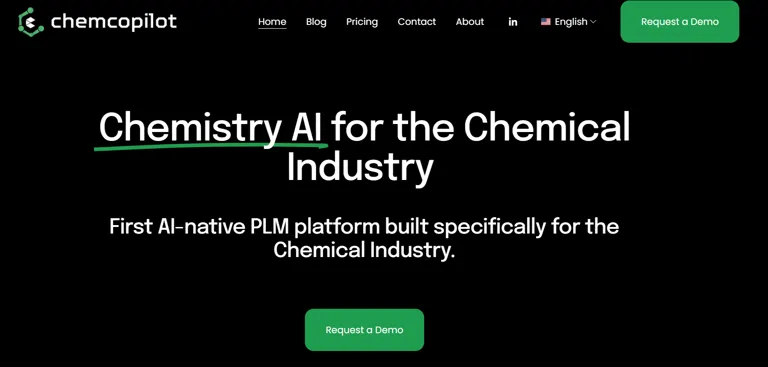
2 ChemCopilot
ChemCopilot is an AI-powered chemistry platform designed to connect research and industrial manufacturing. It predicts reaction conditions, optimizes yield, improves safety, and recommends sustainable chemical pathways, helping researchers and manufacturers reduce failures, lower costs, and make faster data-driven decisions.
Key Features
- Predicts optimal reaction conditions using AI algorithms
- Simulates chemical scale-up processes for manufacturing
- Improves yield, safety, and production efficiency
- Suggests greener and sustainable chemical pathways
Best For
- Chemical engineers
- Industrial manufacturing teams
- Process development specialists
- R&D chemists
- Sustainable chemistry organizations
How to use ChemCopilot?
- Sign up and access the ChemCopilot dashboard
- Input chemical reaction data or process details
- Run AI simulations for reaction optimization
- Analyze recommendations and apply improvements in workflows
Pros
- Reduces experimental failures and production costs
- Supports sustainable and eco-friendly chemistry practices
- Speeds up industrial and research decision-making
- Useful for both laboratories and manufacturing facilities
Cons
- Requires quality input data for accurate predictions
- Advanced industrial features may have a learning curve
- Cloud-based access depends on stable internet connectivity
- Premium plans can be expensive for small teams
Best Use Case
ChemCopilot helps chemical industries optimize manufacturing efficiency, improve reaction safety, and reduce waste during large-scale production. It is also valuable for R&D teams developing sustainable chemical processes and faster experimental workflows.
Limitations
- AI simulations may not fully replicate real industrial conditions
- Limited performance with incomplete or inaccurate datasets
- Human expertise is still necessary for final validation
Pricing Plan
- ChemCopilot offers a free trial with limited AI simulations and reaction optimization tools for basic research needs.
- Paid plans include advanced industrial analytics, scale-up simulations, and expanded features for professional chemical manufacturing teams.
Alternative
DeepChem, Schrödinger, BIOVIA, Chematica
ChemCopilot Official source image
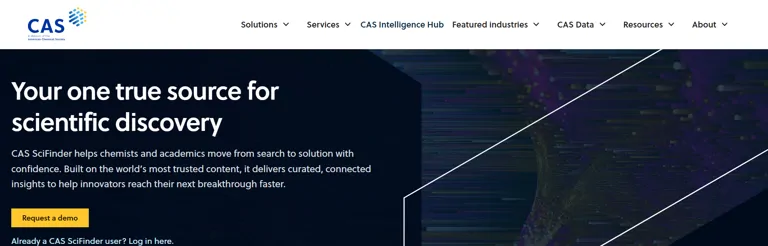
3 CAS SciFinder
CAS SciFinder is a powerful AI-driven chemistry research platform that enables literature, substance, and reaction searches. It provides access to curated databases of compounds, reactions, and patents, offering structure-based search tools and AI-assisted filtering for accurate and efficient chemical research in academia and industry.
Key Features
- Structure-based chemical and reaction searching
- Access to curated scientific literature and patents
- AI-powered filtering for precise research results
- Extensive compound and reaction database coverage
Best For
- Research chemists
- Pharmaceutical scientists
- Materials scientists
- Patent professionals
- Academic institutions
How to use CAS SciFinder?
- Register and log in through institutional access
- Enter chemical structures, names, or keywords
- Use filters to refine literature, reactions, or substances
- Analyze results and export relevant research data
Pros
- Highly reliable and curated scientific database
- Saves time in literature and reaction searches
- Strong structure-searching capabilities
- Widely trusted in academic and industrial research
Cons
- Requires institutional or paid access
- Steep learning curve for new users
- Limited availability for individual users
- Internet dependency for full functionality
Best Use Case
CAS SciFinder supports researchers in finding chemical literature, identifying compounds, analyzing reactions, and discovering patents for drug development and advanced scientific research.
Limitations
- Access is restricted without institutional subscription
- Complex interface for beginners
- Data coverage depends on indexed scientific sources
Pricing Plan
CAS SciFinder offers subscription-based pricing mainly through universities and enterprises, with customized licensing plans depending on research needs and user scale.
Alternative
Reaxys, PubChem, ChemSpider, Scopus
4 Albert Invent
Albert Invent is an AI-powered R&D platform that leverages historical experimental data to generate predictive insights, automate research workflows, and improve decision-making in chemistry. It enhances collaboration, reduces data silos, and streamlines discovery, helping researchers accelerate innovation and optimize experimental outcomes.
Key Features
- AI-driven predictive insights from experimental data
- Workflow automation for chemical research processes
- Centralized data management and collaboration tools
- Improved decision-making for R&D optimization
Best For
- Enterprise R&D teams
- Formulation scientists
- Product development specialists
- Laboratory managers
- Innovation-driven organizations
How to use Albert Invent?
- Create an account and set up your research workspace
- Upload or integrate experimental chemistry data
- Use AI tools to generate insights and predictions
- Collaborate and refine research outcomes in the platform
Pros
- Improves research efficiency and productivity
- Reduces data silos across teams and projects
- Enhances collaboration between researchers
- Supports faster innovation in chemical R&D
Cons
- Requires structured and high-quality data input
- May need training for full platform utilization
- Advanced features can be resource-intensive
- Limited effectiveness with incomplete datasets
Best Use Case
Albert Invent helps chemical researchers accelerate discovery by analyzing experimental data, improving collaboration, and optimizing R&D workflows for faster and more accurate innovation outcomes.
Limitations
- Performance depends on quality of historical data
- Not ideal for small-scale or minimal datasets
- Requires user familiarity with digital R&D systems
Pricing Plan
Albert Invent offers customized enterprise pricing with scalable plans based on team size, data usage, and advanced research automation requirements.
Alternative
DeepChem, Benchling, Schrödinger, CAS SciFinder
5 Luna.ai (formerly partnerships/stealth)
Luna.ai is a generative AI platform for chemistry and biology that designs novel proteins, peptides, and small molecules with optimized therapeutic properties. It enables de novo molecular design and multi-parameter optimization, helping researchers solve complex drug targets and accelerate drug discovery beyond traditional limitations.
Key Features
- Generates novel proteins, peptides, and small molecules
- AI-driven de novo molecular design capabilities
- Multi-parameter optimization for drug properties
- Supports complex drug target discovery workflows
Best For
- Chemistry researchers
- Laboratory professionals
- Scientific research teams
- Academic institutions
- Innovation-focused organizations
How to use Luna.ai?
- Sign up and access the molecular design workspace
- Input target biological or chemical parameters
- Run AI models for molecule or protein generation
- Evaluate and refine outputs for further research
Pros
- Accelerates early-stage drug discovery
- Enables completely new molecular designs
- Reduces time in identifying viable drug candidates
- Supports advanced biological and chemical research
Cons
- Requires strong domain expertise for interpretation
- High computational requirements for advanced models
- Limited accessibility depending on research access
- Not fully validated for all real-world applications
Best Use Case
Luna.ai helps researchers design new drug candidates by generating optimized proteins and molecules, enabling faster discovery of treatments for complex diseases and biological targets.
Limitations
- AI-generated molecules still require experimental validation
- Performance depends on quality of input constraints
- Limited transparency in deep generative model outputs
Pricing Plan
Luna.ai offers research-based access with custom pricing depending on project scale, while enterprise solutions include advanced generative modeling and collaboration features.
Alternative
AlphaFold, Atomwise, ChemGPT, Schrödinger
6 Schrödinger Materials Science Suite
Schrödinger Materials Science Suite is a hybrid AI and physics-based platform that combines molecular dynamics, quantum chemistry, and machine learning. It enables highly accurate drug and materials design through virtual screening, docking, property prediction, and collaborative computational chemistry workflows.
Key Features
- Physics-based molecular dynamics simulations
- AI-enhanced drug and materials design tools
- Virtual screening and molecular docking (Glide)
- Collaborative research environment (Maestro, LiveDesign)
Best For
- Computational chemists
- Materials scientists
- Battery researchers
- Semiconductor engineers
- Advanced materials R&D teams
How to use Schrödinger Materials Science Suite?
- Install or access the Schrödinger platform via institutional license
- Set up project workspace in Maestro interface
- Run molecular simulations or docking studies
- Analyze predictions and refine compounds or materials
Pros
- Extremely high accuracy in molecular modeling
- Combines AI with physics-based simulations
- Strong support for drug discovery and materials science
- Advanced visualization and collaboration tools
- Cons
- Very expensive for individual users or small labs
- Requires high computational resources
- Steep learning curve for beginners
- Complex setup and workflow management
Best Use Case
- Schrödinger Materials Science Suite is used in pharmaceutical research, materials engineering, and computational chemistry to design new drugs, optimize molecules, and predict material properties with high accuracy.
Limitations
- Requires advanced computational expertise
- Not suitable for quick or lightweight analysis
- Heavy dependency on computing infrastructure
Pricing Plan
Schrödinger offers enterprise and institutional licensing with customized pricing based on modules, computational needs, and research scale.
Alternative
OpenEye, BIOVIA, Gaussian, DeepChem
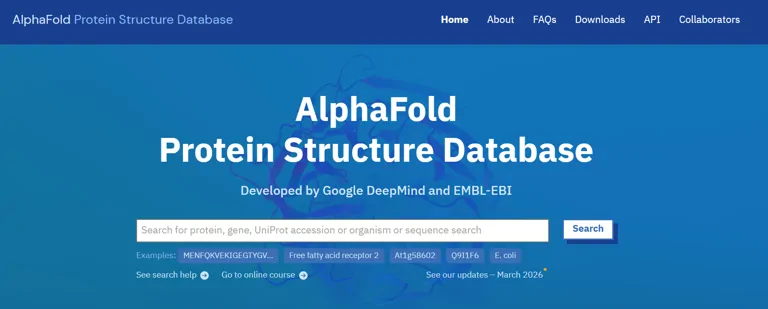
7 AlphaFold
AlphaFold by DeepMind is a breakthrough AI system that predicts 3D protein structures from amino acid sequences. It has transformed structural biology by delivering highly accurate models, supporting large-scale research, and accelerating drug discovery through its extensive protein structure database.
Key Features
- Predicts accurate 3D protein structures from sequences
- Uses deep learning for structural biology modeling
- Provides access to a large precomputed protein database
- Supports drug discovery and biological research
Best For
- Structural biologists
- Molecular biologists
- Protein researchers
- Biotechnology companies
- Drug discovery teams
How to use AlphaFold?
- Access the AlphaFold database or modeling interface
- Input amino acid sequences of target proteins
- Run prediction models to generate 3D structures
- Analyze and export structural data for research
Pros
- Extremely high accuracy in protein structure prediction
- Free access to a large structural database
- Speeds up biological and pharmaceutical research
- Reduces need for expensive lab-based structure analysis
Cons
- Limited to protein structure prediction only
- Does not model all protein complexes equally well
- Requires expertise to interpret structural outputs
- No direct experimental validation included
Best Use Case
AlphaFold is widely used in drug discovery, disease research, and molecular biology to understand protein structures and accelerate development of new therapeutic treatments.
Limitations
- Cannot fully replace experimental structural biology methods
- Less effective for highly dynamic or complex protein systems
- Predictions still require biological validation
Pricing Plan
AlphaFold offers free academic and research access through its database, while advanced computational tools and integrations may require institutional or enterprise arrangements.
Alternative
RoseTTAFold, Rosetta, DeepMind tools, Schrödinger
AlphaFolld Official source image
8 Atomwise
Atomwise uses AI-powered AtomNet technology to predict molecule-protein interactions, accelerating drug discovery, virtual screening, and lead optimization processes. When analyzing the physical properties of new chemical compounds, scientists often utilize specialized software found in our ultimate list of AI tools for physics to model atomic interactions and material stress.
Key Features
- AI-based molecule–protein interaction prediction
- High-throughput virtual screening using AtomNet
- Supports lead optimization in drug discovery
- Identifies potential drug candidates efficiently
Best For
- Drug discovery companies
- Medicinal chemists
- Pharmaceutical researchers
- Biotech startups
- AI-driven molecular screening teams
- How to use Atomwise?
- Access the Atomwise platform through research collaboration
- Input target protein structures or disease-related data
- Run AI-driven virtual screening models
- Analyze predicted compounds for further testing
Pros
- Significantly speeds up drug discovery process
- Reduces cost of early-stage compound testing
- High accuracy in virtual molecular screening
- Useful for pharmaceutical and biotech research
Cons
- Limited access for independent researchers
- Requires expert interpretation of AI results
- Dependent on quality of biological input data
- Not a fully standalone experimental solution
Best Use Case
Atomwise is used in pharmaceutical research to identify drug candidates, predict molecular interactions, and optimize compounds for diseases, enabling faster and more efficient drug development pipelines.
Limitations
- Requires experimental validation of predictions
- Restricted access for most users
- Performance depends on available structural data
Pricing Plan
Atomwise operates on a collaboration-based pricing model with customized enterprise agreements, typically tailored for pharmaceutical companies and research institutions.
Alternative
DeepChem, Schrödinger, IBM RXN for Chemistry, AlphaFold
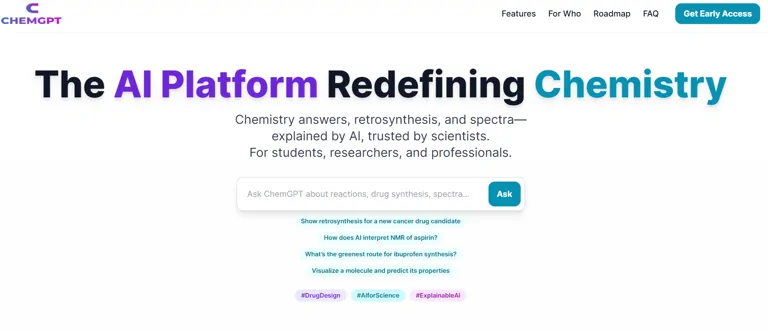
9 ChemGPT
ChemGPT is an AI-powered chemistry assistant that helps solve equations, explain chemical processes, simplify complex topics, and support learning and research tasks. It is also useful to write notes of research, and many students also get help from AI tools for writing to polish their research papers.
Key Features
- Solves and explains chemical equations
- Simplifies complex chemistry concepts
- Assists in research notes and explanations
- Supports learning and academic chemistry tasks
Best For
- Research chemists
- Chemistry students
- University educators
- Laboratory professionals
- Scientific researchers
How to use ChemGPT?
- Open the ChemGPT interface or platform
- Enter chemical questions, equations, or topics
- Get AI-generated explanations and solutions
- Refine or explore related chemistry concepts
Pros
- Easy to use for students and beginners
- Provides quick explanations of chemistry topics
- Helps improve understanding of difficult concepts
- Useful for academic writing and revision
Cons
- Not always accurate for advanced research-level chemistry
- Limited in experimental or lab-based applications
- Requires verification for complex solutions
- Depends on AI understanding of input context
Best Use Case
ChemGPT is used by students and researchers to understand chemical reactions, solve problems, prepare study notes, and simplify complex chemistry topics for learning and academic support.
Limitations
- Not a substitute for professional lab research
- Limited accuracy in highly advanced chemical modeling
- May require cross-checking with textbooks or experts
Pricing Plan
ChemGPT typically offers free access for basic learning and explanation features, while advanced tools for research assistance and writing support may require paid plans.
Alternative
ChatGPT, ChemCopilot, IBM RXN for Chemistry, DeepChem
Chemgpt official source image
10 Chemistry Assistant by HyperWrite
Chemistry Assistant by HyperWrite is an AI-powered tool that helps students and professionals solve chemistry problems by breaking down complex concepts like stoichiometry and reaction mechanisms into clear, step-by-step explanations for better learning and understanding.
Key Features
- Step-by-step chemistry problem solving
- Explains stoichiometry and reaction mechanisms
- Interactive AI-based learning support
- Useful for homework and academic assistance
Best For
- Chemistry students
- Teachers and educators
- Laboratory researchers
- Technical writers
- Science professionals
How to use Chemistry Assistant by HyperWrite?
- Open the HyperWrite Chemistry Assistant tool
- Enter your chemistry question or problem
- Review step-by-step AI explanation
- Apply the solution for study or assignments
Pros
- Easy-to-understand explanations for beginners
- Improves conceptual understanding of chemistry
- Saves time in solving academic problems
- Interactive learning experience
Cons
- Limited use for advanced research-level chemistry
- Requires careful verification of answers
- Depends on clarity of user input
- Not suitable for experimental lab work
Best Use Case
Chemistry Assistant by HyperWrite is used by students to solve homework problems, understand reaction steps, and learn core chemistry concepts with guided AI explanations.
Limitations
- Not designed for professional research applications
- May oversimplify complex chemical processes
- Accuracy depends on input quality and context
Pricing Plan
Chemistry Assistant by HyperWrite offers free basic access for students, while premium plans unlock advanced writing assistance and enhanced AI learning features.
Alternative
ChemGPT, ChatGPT, Wolfram Alpha, Socratic by Google
11 Citrine Informatics
Citrine Informatics is an AI-driven materials discovery platform that uses machine learning to predict material properties and optimize development processes. It enhances data management, automates workflows, and supports sustainable innovation for both research and industrial applications.
Key Features
- AI-based prediction of material properties
- Machine learning for materials discovery
- Workflow automation for R&D processes
- Centralized data management and analysis
Best For
- Materials scientists
- Industrial R&D teams
- Manufacturing companies
- Product development engineers
- Materials innovation specialists
How to use Citrine Informatics?
- Sign up and create a materials research project
- Upload or connect experimental datasets
- Apply AI models to predict material properties
- Analyze results to optimize material development
Pros
- Speeds up materials discovery and innovation
- Reduces experimental trial-and-error costs
- Strong support for data-driven decision-making
- Suitable for both academic and industrial use
Cons
- Requires high-quality structured data
- Can be complex for beginners
- Limited effectiveness with small datasets
- Enterprise features may be costly
Best Use Case
Citrine Informatics is used in materials science and industrial research to discover new materials, optimize product performance, and accelerate innovation in energy, manufacturing, and sustainability sectors.
Limitations
- Performance depends heavily on data quality
- Requires expertise in materials informatics
- Not ideal for small-scale or simple experiments
Pricing Plan
Citrine Informatics offers flexible pricing with academic access and customized enterprise plans based on data scale, project requirements, and advanced analytics needs.
Alternative
Schrödinger, Materials Studio, DeepChem, Materials Project
12 Molecule.one
Molecule.one is an AI-powered platform that supports retrosynthesis planning and chemical synthesis by helping chemists design efficient synthetic routes for complex molecules. It integrates with laboratory workflows, enables real-time collaboration, reduces trial-and-error, and accelerates discovery in academic and industrial research.
Key Features
- AI-driven retrosynthesis route planning
- Efficient synthetic pathway design for complex molecules
- Real-time collaboration for research teams
- Integration with laboratory and research workflows
Best For
- Synthetic chemists
- Medicinal chemists
- Pharmaceutical researchers
- Contract research organizations (CROs)
- Organic chemistry laboratories
How to use Molecule.one?
- Create an account and access the retrosynthesis platform
- Input the target molecule structure
- Run AI-based synthesis route generation
- Review and refine suggested chemical pathways
Pros
- Speeds up chemical synthesis planning
- Reduces experimental trial-and-error
- Improves research collaboration efficiency
- Useful for both academic and industrial chemistry
Cons
- Requires accurate molecular input for best results
- Advanced features may need training to use effectively
- Dependent on computational predictions, not lab validation
- Limited offline functionality
Best Use Case
Molecule.one is used in drug discovery and chemical research to design efficient synthesis routes, optimize molecular production, and accelerate development of complex compounds in academic and industrial settings.
- Limitations
- Predictions still require experimental validation
- Performance depends on data quality and input accuracy
- Not a replacement for laboratory synthesis expertise
Pricing Plan
Molecule.one offers subscription-based access with flexible academic and enterprise pricing depending on research scale and collaboration needs.
Alternative
IBM RXN for Chemistry, ChemDraw, Reaxys, Schrödinger
13 Benchling
Benchling is a cloud-based laboratory management platform that streamlines electronic lab notebook (ELN) tasks, experiment tracking, data analysis, and reporting. Its AI-powered tools improve workflow efficiency, reduce manual effort, and enhance accuracy in biotech and academic research environments.
Key Features
- Electronic lab notebook (ELN) for experiment tracking
- AI-assisted data management and analysis
- Workflow automation for lab processes
- Collaboration tools for research teams
Best For
- Biotechnology companies
- Pharmaceutical organizations
- Life sciences researchers
- Laboratory managers
- Collaborative R&D teams
How to use Benchling?
- Create an account and set up your lab workspace
- Record experiments in the electronic lab notebook
- Upload and analyze research data using built-in tools
- Collaborate and share results with team members
Pros
- Improves lab organization and documentation
- Reduces manual data entry and errors
- Enhances collaboration among research teams
- Widely used in biotech and academic research
Cons
- Requires training for advanced features
- Internet connection is necessary for access
- Can be complex for beginners
- Premium features may be costly for small labs
Best Use Case
Benchling is used in biotech and academic laboratories to manage experiments, track research data, streamline workflows, and improve collaboration in molecular biology and chemistry research.
Limitations
- Limited offline functionality
- Advanced features depend on subscription level
- Requires consistent data entry for best results
Pricing Plan
Benchling offers a free basic plan for academic use with core ELN features, while advanced enterprise plans include AI-driven analytics, automation, and compliance tools.
Alternative
LabArchives, LabWare, Labguru, Dotmatics
14 Syntelly
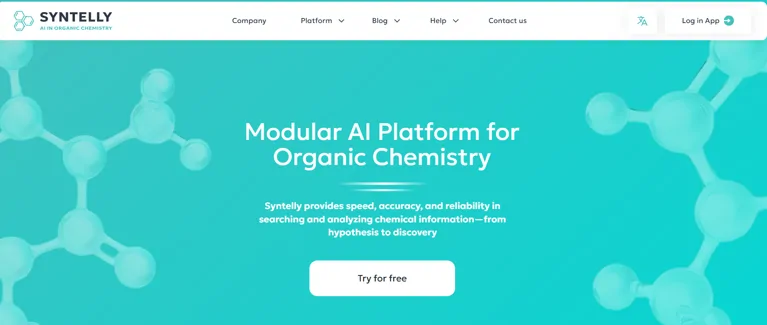
Syntelly is an AI-powered platform for organic and medicinal chemistry that predicts molecular properties, recognizes chemical structures, and streamlines research workflows, supporting faster and more accurate decision-making in both academic and industrial environments.
Key Features
- Predicts molecular properties using AI models
- Chemical structure recognition and analysis
- Supports medicinal and organic chemistry research
- Workflow optimization for chemical R&D
Best For
Organic chemists
Medicinal chemists
Pharmaceutical researchers
Chemical manufacturers
Laboratory professionals
How to use Syntelly?
- Sign up and access the Syntelly platform
- Upload or draw chemical structures
- Run AI-based property prediction tools
- Analyze outputs for research and development
Pros
- Improves accuracy in molecular predictions
- Saves time in chemical analysis workflows
- Useful for both students and professional researchers
- Simplifies complex chemistry tasks
Cons
- Requires correct chemical structure input
- Limited use without internet connectivity
- Advanced features may require training
- Not a replacement for laboratory validation
Best Use Case
Syntelly is used in medicinal and organic chemistry research to predict molecular behavior, analyze compounds, and speed up drug discovery and chemical development processes.
- Limitations
- AI predictions still require experimental validation
- Performance depends on data quality and input accuracy
- Limited effectiveness for highly novel compounds
Pricing Plan
Syntelly offers flexible subscription-based pricing with basic academic access and advanced enterprise features for professional research and industrial applications.
Alternative
ChemDraw, DeepChem, Schrödinger, CAS SciFinder
Syntelly Official source image
How to Choose the Right AI Chemistry Tool
Selecting the right AI chemistry platform depends on your research objectives, laboratory workflow, and technical requirements. Some tools specialize in reaction prediction and retrosynthesis, while others focus on drug discovery, materials science, protein analysis, or laboratory collaboration. Please Evaluate its features, pricing, integrations, ease of use, and scalability will help you choose a solution that aligns with your research goals and budget.
Consider These Factors
- Define your primary research or laboratory objective
- Choose tools designed for your chemistry discipline
- Evaluate AI accuracy and prediction capabilities
- Compare pricing and licensing options
- Check integration with existing laboratory software
- Consider ease of use and learning curve
- Look for collaboration and data-sharing features
- Assess scalability for future research needs
- Review customer support and documentation
- Read independent reviews and real-world user feedback
Common Challenges of AI in Chemistry
Despite its potential, AI in chemistry faces challenges including poor-quality datasets, black-box predictions, limited transparency, and ethical concerns around privacy and misuse. Addressing these issues is essential for building trust, improving accuracy, and ensuring responsible adoption of AI-driven tools in chemical research and drug discovery.
Challenges
- High-quality training data is not always available
- AI predictions still require laboratory verification
- Some platforms have a steep learning curve
- Enterprise solutions can be expensive
- Limited performance for rare or novel chemical reactions
- Integration with existing laboratory workflows may be complex
- Data privacy and intellectual property concerns
- Computational requirements can be resource-intensive
- Results may vary depending on model accuracy
- Human expertise remains essential for final decision-making
Future of AI in Chemistry
The future of AI in chemistry points toward increasingly autonomous and intelligent laboratories where machine learning, robotics, and advanced simulations work together to accelerate scientific discovery. AI is expected to play a larger role in designing new materials, developing life-saving medicines, optimizing sustainable chemical processes, and reducing experimental costs. As foundation models and laboratory automation continue to evolve, chemists will be able to make faster, more accurate, and data-driven research decisions than ever before.
FAQs
1. What is the role of AI in modern chemistry labs?
AI helps chemists analyze large datasets, predict chemical reactions, optimize synthesis pathways, and automate repetitive laboratory tasks. This enables faster research, more accurate decision-making, and improved efficiency across academic and industrial chemistry labs.
2. Which AI platforms are most widely used in chemistry?
Some of the most popular AI chemistry platforms include IBM RXN for Chemistry, CAS SciFinder, AlphaFold, Atomwise, Benchling, Schrödinger Materials Science Suite, ChemGPT, and Molecule.one. Each specializes in areas such as reaction prediction, literature research, protein modeling, or drug discovery.
3. How does AI improve drug discovery and materials development?
AI accelerates drug discovery by screening millions of compounds, predicting molecular interactions, and identifying promising drug candidates. In materials science, AI helps researchers discover new materials, optimize formulations, and reduce the time and cost required for experimentation.
4. What are the challenges of using AI in chemistry?
Common challenges include the need for high-quality training data, computational costs, experimental validation, integration with laboratory workflows, and concerns about data privacy. AI predictions should always be verified through scientific testing before practical implementation.
5. Can students and researchers access these AI tools?
Yes. Many AI chemistry platforms provide free academic access, student licenses, or institutional subscriptions. Universities, research organizations, and pharmaceutical companies often use these tools to support education, experimentation, and collaborative research.
6. Which AI chemistry tool is best for reaction prediction?
IBM RXN for Chemistry and Molecule.one are among the leading platforms for AI-powered reaction prediction and retrosynthesis planning. They help chemists evaluate reaction outcomes, identify synthesis pathways, and accelerate laboratory research.
7. Are AI chemistry tools suitable for small laboratories?
Yes. Many cloud-based AI chemistry tools are designed for laboratories of all sizes. Small research teams, startups, and academic labs can benefit from affordable or free plans that provide access to advanced reaction prediction, molecular analysis, and scientific research capabilities.
8. Can AI replace chemists in laboratory research?
No. AI is designed to assist chemists rather than replace them. While it can automate data analysis and generate predictions, human expertise remains essential for designing experiments, interpreting results, ensuring safety, and validating scientific discoveries.
9. How do I choose the best AI chemistry tool for my research?
Start by identifying your research goals, such as reaction prediction, drug discovery, literature search, materials science, or laboratory management. Then compare each platform based on features, AI capabilities, pricing, ease of use, integrations, and scalability to find the best fit.
10. What is the future of AI in chemistry?
AI is expected to play an even greater role in autonomous laboratories, molecular design, sustainable chemistry, drug development, and materials discovery. As machine learning models become more advanced, AI will continue helping scientists conduct faster, more efficient, and data-driven research.
Conclusion
Artificial intelligence is reshaping modern chemistry by helping researchers analyze complex data, predict chemical reactions, accelerate drug discovery, optimize laboratory workflows, and make faster, more informed scientific decisions. Whether you're working in academia, pharmaceuticals, biotechnology, or industrial research, choosing the right AI chemistry platform—such as IBM RXN for Chemistry, CAS SciFinder, AlphaFold, Atomwise, Benchling, or Molecule.one—depends on your research objectives, budget, and workflow requirements. As scientific research becomes increasingly data-driven, combining these specialized chemistry platforms with the best AI tools for data analysis can unlock deeper insights, improve experimental accuracy, and streamline decision-making across every stage of the research process. By adopting the right mix of AI-powered tools, chemists can boost productivity, accelerate innovation, and stay competitive in the rapidly evolving world of scientific discovery.